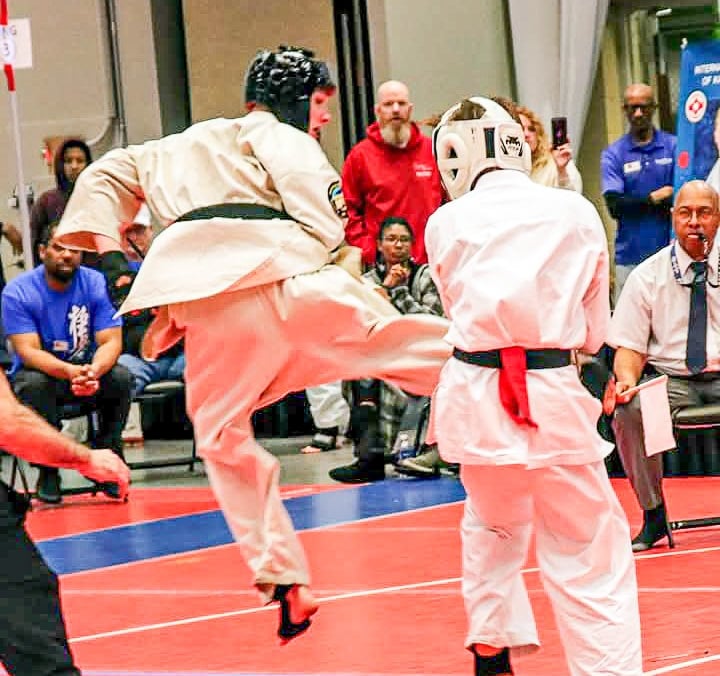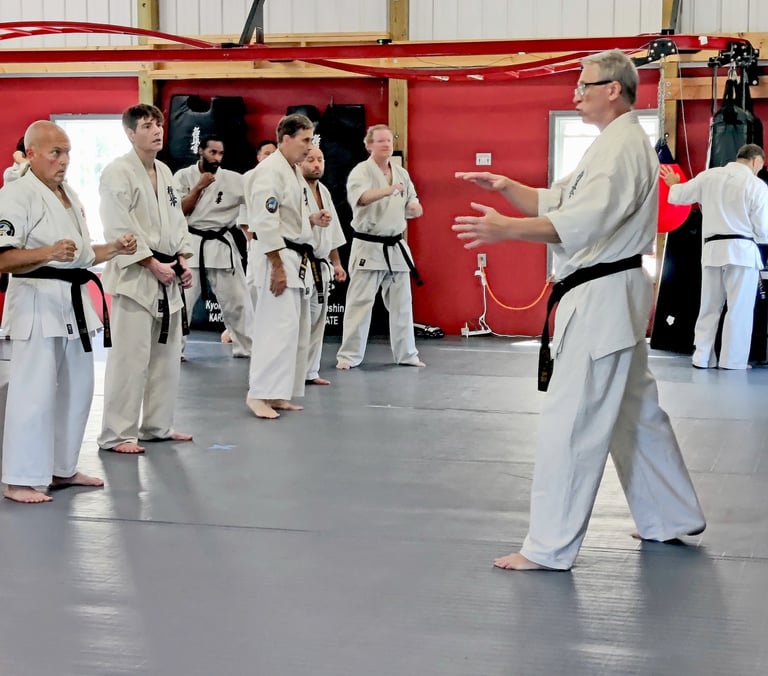
|

The word kata means "shape" or "form".
The kanji for kata (the lower left Japanest character on the right) is
composed of the following characters:
|
 |
Katachi
meaning "Shape", and |
|
 |
Kai meaning
"Cut". |
|
 |
Tsuchi
meaning "Earth" or "Soil". |
Literally translated, kata means "shape which cuts the ground".
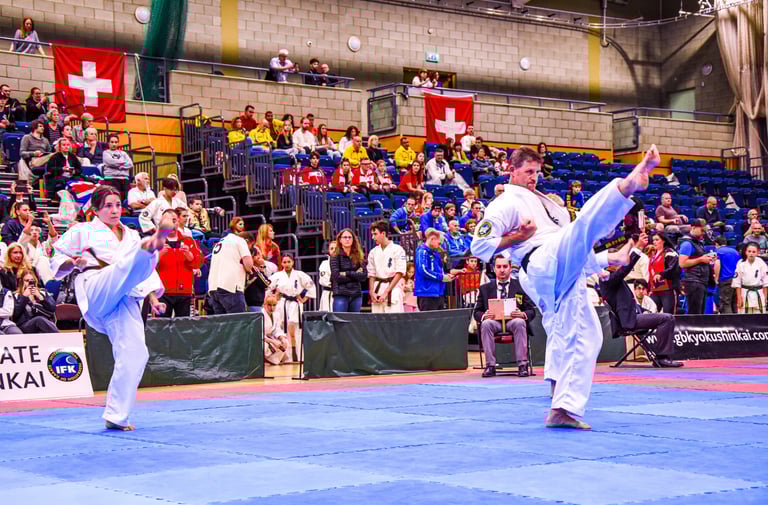
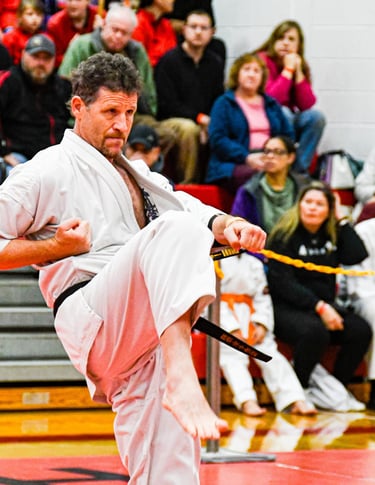
A kata is a sequence of blocks, kicks and punches from one or more stances,
involving movement forward, backward and to the sides. The number of
movements and their sequence are very specific. The balance between
offensive and defensive techniques, the stances used and the direction and flow
of movement all serve to give each kata its distinctive character.
Through the practice of kata, the traditional techniques used for fighting
are learned. Balance, coordination, breathing and concentration are also
developed. Done properly, kata are an excellent physical exercise and a
very effective form of total mind and body conditioning. Kata embodies the
idea of renma, or "polishing" – with diligent practice, the moves of the
kata become further refined and perfected. The attention to detail that is
necessary to perfect a kata cultivates self discipline.
Through concentration, dedication and practice, a higher level of learning
may be achieved, where the kata is so ingrained in the subconscious mind that no
conscious attention is needed. This is what the Zen masters call mushin,
or "no mind." The conscious, rational thought practice is not used at all – what
was once memorized is now spontaneous.
Mas Oyama said that one should "think of karate as a language – the kihon
(basics) can be thought of as the letters of the alphabet, the kata
(forms) will be the equivalent of words and sentences, and the kumite
(fighting) will be analogous to conversations." He believed that it was
better to master just one kata than to only half-learn many.
Mas Oyama also emphasized the three fundamental
principles of kata:
 |
Waza no Kankyō:
The Relative Tempo of Techniques. |
|
The tempo of the kata varies – some techniques are
performed quickly, while others are done more slowly. |
|
 |
Chikara no Kyōjaku:
The Relative Force of Power. |
|
The power of a technique derives from the proper balance
between strength and relaxation. |
|
 |
Iki no Chōsei:
The Control of Breathing. |
|
The correct timing (inhaling and exhaling) and force of
the breaths (kiai, ibuki or nogare) are essential
for proper techniques. |
The practice of traditional kata is also a way for the karateka to pay
respect to the origins and history of Kyokushin Karate and the martial arts in
general.
Origins
Kyokushin kata are often categorized as "Northern Kata" or "Southern Kata,"
based upon the origin and development of the kata and the style of its
techniques.
The Northern Kata
are similar to those found in Shotokan karate, since they were developed from
Mas Oyama's training under Gichin Funakoshi. Master Funakoshi derived the
kata from the Shurite system of Okinawan karate, which originated from northern
Chinese kempo (Shaolin). The Northern kata generally involve longer
movements and a greater fighting distance between opponents (maai), based
on the broad, open terrain of northern China. Techniques are generally
longer and straighter than those of the Southern kata. The Northern Kata
include:
- Taikyoku sono Ichi, Ni and San
- Pinan sono Ichi, Ni, San, Yon and Go
- Yansu
- Tsuki no Kata
- Kankū Dai
- Sushiho
The Southern Kata
are similar to those found in Goju Ryu karate, since they were developed from
Mas Oyama's training under Nei-Chu So. Master So was the top student of
Gogen Yamaguchi, the top Goju practitioner in Japan. Chojun Miyagi
developed Goju Ryu from the Nahate system of Okinawan karate, which originated
from southern Chinese kempo. The Southern kata generally involve shorter
movements and a closer fighting distance between opponents (maai), based
on the slippery, wet terrain of southern China. Techniques are generally
tighter and more circular than those of the Northern kata. The Southern
Kata include:
- Sanchin no Kata
- Gekisai Dai and Shō
- Tenshō
- Saiha
- Seienchin
- Garyū
- Seipai
Meanings
 |
Taikyoku is literally
translated as "grand ultimate", and in Chinese, the kanji characters
are pronounced
Tai Chi. The word Taikyoku can also mean overview or
the whole point – seeing the whole rather than focusing on the individual
parts, and keeping an open mind or beginner's mind. The beginner's
mind is what is strived for during training and in life. The
beginner's mind does not hold prejudice and does not cling to a narrow view.
The beginner's mind is open to endless possibilities. |
|
 |
Pinan is the Okinawan
pronunciation of the kanji characters for peace and relaxation
(pronounced Heian in Japanese). Though the physical moves of
kata involve techniques used for fighting, the purpose of kata is to develop
a calm, peaceful mind and harmony between the mind and body. |
|
 |
Sanchin literally means
"three battles" or "three conflicts". It is the principal kata in
certain Okinawan karate styles, such as Goju Ryu and Uechi Ryu, and it is
likely one of the oldest kata. Certain legends attribute the creation
of Sanchin to Bodhidharma in the early sixth century. Sanchin kata
seeks to develop three elements at the same time:
– The mind, body and the techniques,
– The internal organs, circulation and the nervous
system, and
– The three ki, located in:
– the top of the
head (tento),
– the diaphragm (hara),
and
– the lower abdomen
(tan den).
Sanchin is an isometric kata where each move is performed in a state of
complete tension, accompanied by powerful, deep breathing (ibuki)
that originates in the lower abdomen (tan den). The practice of
Sanchin not only leads to the strengthening of the body, but to the
development of the inner power (ki) and the coordination of mind and
body. |
|
 |
Gekisai means conquer
and occupy. The name is derived from the characters Geki,
meaning attack or conquer, and Sai, meaning fortress or stronghold
(literally translated as "closed", "shut" or "covered"). The word
Gekisai can also mean demolish, destroy or pulverize. The
katas teach strength through fluidity of motion, mobility and the
utilization of various techniques. Flexibility of attack and response
will always be superior to rigid and inflexible strength. (Gekisai Dai
and Gekisai Sho mean "larger" and "smaller" Gekisai, respectively.) |
|
 |
Yansu is derived from
the characters Yan, meaning safe, and Su, meaning three.
The name is attributed to that of a Chinese military attaché to Okinawa in
the 19th Century. The word yansu also means to keep pure,
striving to maintain the purity of principles and ideals rather than
compromising for expediency. |
|
 |
Tsuki no by its very
name is a punching kata (there is only one kick and just a few blocks in the
entire kata). The word Tsuki can also mean fortune and luck.
Good fortune and luck does not come by waiting. For every punch in
this kata, envision that a personal barrier is being broken down.
Strong, persistent effort directed at problems will bring good fortune. |
|
 |
Tenshō
means rolling or fluid hand, literally translated as "rotating palms".
Tenshō is the soft and circular (yin) counterpart to the hard and linear
(yang) Sanchin kata. Not only was Tenshō one of Mas Oyama's
favorite kata, he considered it to be the most indispensable of the
advanced kata:
Tenshō is a basic illustration of the
definition of Karate, derived from Chinese kempo, as a technique of
circles based on points.
Tenshō should be a prime object of practice
because, as a psychological and theoretical support behind karate
training and as a central element in basic karate formal exercises, it
has permeated the techniques, the blocks and the thrusts, and is
intimately connected with the very life of karate.
A man who has practiced Tenshō kata a
number of thousands of times and has a firm grasp of its theory can not
only take any attack, but can also turn the advantage in any attack, and
will always be able to defend himself perfectly.
|
|
 |
Saiha means extreme
destruction, smashing or tearing. The word Saiha can also mean
great wave, the source of the IFK logo. No matter how large a problem
is encountered, with patience, determination and perseverance (Osu)
one can rise above and overcome it, or smash through and get beyond it. |
|
 |
Kankū means sky gazing.
Literally translated, Kan means "view", and Kū means
"universe", "air", "emptiness" or "void" (the same character as Kara
in karate). The first move of the kata is the formation of an opening
with the hands above the head, through which one gazes at the universe and
rising sun. The significance is that no matter what problems are
faced, each day is new and the universe is waiting. Nothing is so
terrible that it affects the basic reality of existence. |
|
 |
Seienchin means
conqueror and subdue over a distance, or attack the rebellious outpost.
In feudal Japan, Samurai warriors would often go on expeditions lasting many
months, and they needed to maintain their strength and spirit over a long
period of time. This kata is long and slow, with many techniques
performed from kiba dachi (horseback stance). The legs usually
become very tired in this kata, and a strong spirit is needed to persevere,
instead of giving up. The word Seienchin can also mean to pull
in battle. |
|
 |
Sushiho means 54 steps.
Sushiho is derived from the words Useshi, the Okinawan
pronunciation of the kanji characters for 54 (pronounced Go Jū Shi
in Japanese), and Ho, meaning walk or step. Other karate styles
call this advanced kata Gojūshiho. |
|
 |
Garyū means reclining
dragon. In Japanese philosophy, a great man who remains in obscurity
is called a Garyū. A dragon is all-powerful, but a reclining dragon
chooses not to display his power until it is needed. Likewise, a true
karateka does not brag about or show off his abilities. He never
forgets the true virtue of humility. |
|
 |
Seipai is the Okinawan
pronunciation of the kanji characters for 18 (pronounced Jū Hachi
in Japanese). In other karate styles, this kata is sometimes called
Seipaite, or eighteen hands. The number 18 is derived from the
Buddhist concept of 6 x 3, where six represents color, voice, taste, smell,
touch and justice and three represents good, bad and peace. |
IFK Kata Requirements
|
|
10th Kyu |
Taikyoku sono Ichi |
|
|
|
9th Kyu |
Taikyoku sono Ni |
|
|
|
8th Kyu |
Taikyoku sono San |
|
|
|
7th Kyu |
Pinan sono Ichi |
|
|
|
6th Kyu |
Pinan sono Ni |
|
|
|
5th Kyu |
Pinan sono San |
|
|
|
4th Kyu |
Sanchin no Kata with Ibuki |
|
|
|
3rd Kyu |
Pinan sono Yon |
|
Sanchin no Kata with Kiai |
|
|
|
2nd Kyu |
Pinan sono Go |
|
Gekisai Dai |
|
|
|
1st Kyu |
Yansu |
|
Tsuki no Kata |
|
|
|
Shodan |
Tenshō |
|
Saiha |
| Taikyoku Sono Ichi/Ni in Ura |
| Taikyoku Sono San in Ura |
|
|
|
Nidan |
Kankū Dai |
|
Gekisai Shō |
| Seienchin |
| Pinan Sono Ichi in Ura |
|
|
|
Sandan |
Sushiho |
|
Garyū |
| Seipai |
| Pinan Sono Ni in Ura |
|